Compostable cutlery: what it is for and where it fails

Plant-based disposable cutlery is widely used for catering and events, and it is often misunderstood in both directions — treated either as a complete solution or dismissed as pointless. The truth depends almost entirely on what happens to it after use, and on the conditions available to break it down.
Most of it needs industrial composting
The common plant-based plastics require sustained high temperatures to break down in a reasonable time. A domestic compost heap rarely gets hot enough for long enough.
In a home heap, expect these to persist far longer than the packaging implies. That is not a defect; it is the specified condition not being met.
In landfill they behave much like plastic
Buried without oxygen and heat, compostable cutlery does not usefully degrade. The environmental benefit depends on the disposal route being available and used.
So the honest question before buying is whether there is a commercial composting stream that will actually take it.
They are strong enough for real food
Modern plant-based cutlery handles hot food and cutting reasonably well, which older versions did not. Heavy-duty grades are noticeably sturdier than the thin ones.
For catering, the weight of the utensil is what determines whether it feels acceptable to use, and it is worth paying for.
Where they are genuinely the right choice
Events, catering, offices and any situation where washing up is impossible and the alternative is conventional plastic. There they are a clear improvement.
They are also useful where hygiene rules require single use, which is a legitimate constraint rather than a convenience.
Where reusables are simply better
In a household with a dishwasher, reusable cutlery wins on every measure including cost. Compostable disposables are not a household substitute.
Being clear about that distinction is what keeps them useful rather than a token gesture.
Storage: keep them dry
Plant-based materials are more sensitive to humidity than conventional plastic, and a box stored somewhere damp can soften or discolour over months.
Store sealed and dry, and they keep their strength until used.
Disposables on this shelf
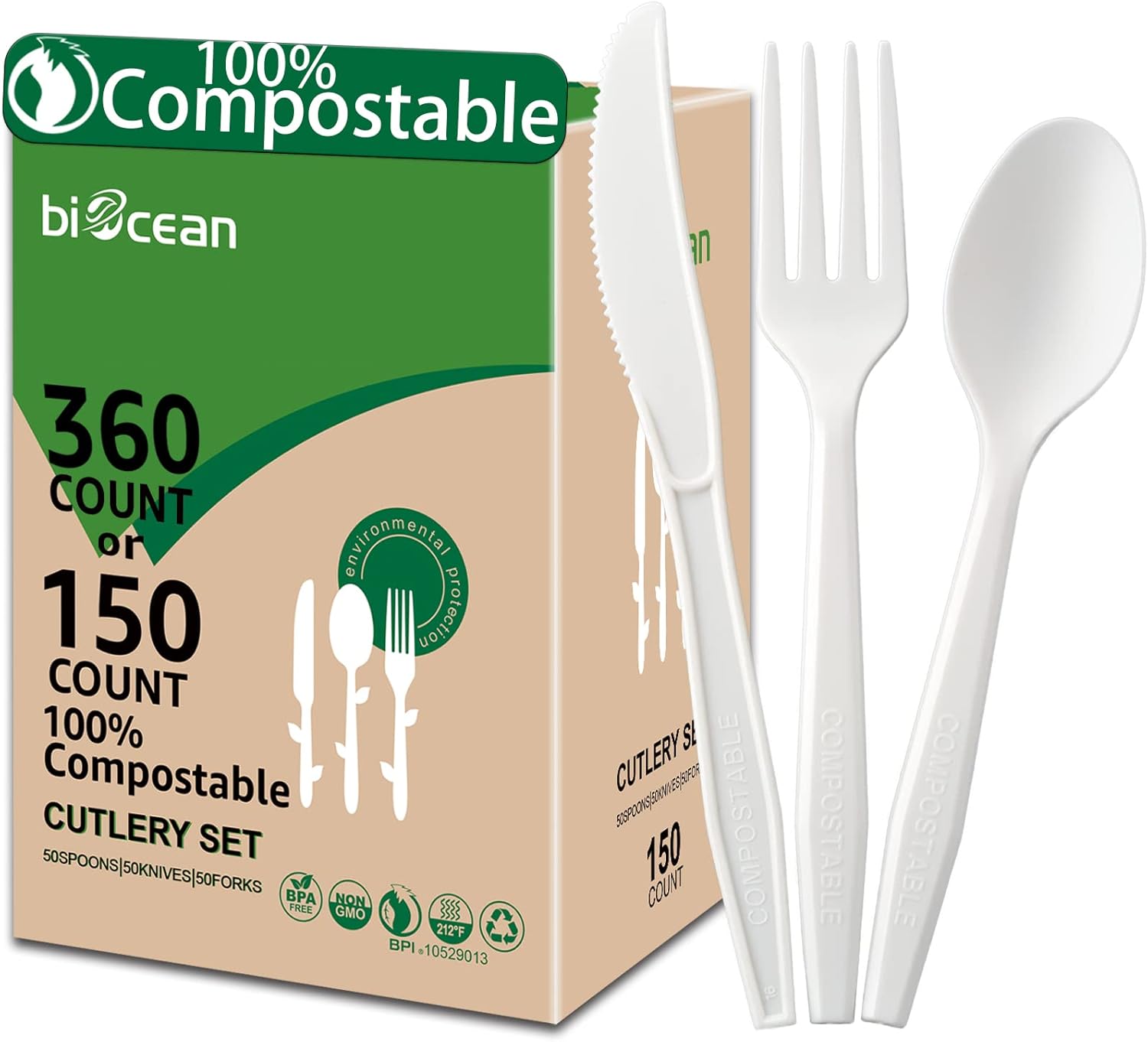
The compostable utensil sets here are the heavy-duty plant-based type, sold in the quantities that suit catering and events. On our own shelf that range currently runs from $39.99 for the biocean 360-Count Compostable Utensils Set: Heavy-Duty Plant-Based Forks, Spoons & Knives up to $39.99 for the biocean 360-Count Compostable Utensils Set: Heavy-Duty Plant-Based Forks, Spoons & Knives.
All of the following are filed under Disposable Tableware — 1 product at present. Listed prices are checkout prices; case quantities are priced on the same basis.
Related reading
Two other pieces on this site cover ground next to this one. Bulk buying saves money on the things you get through and wastes it on the things you do not. And on a related note, a cellulose dishcloth going stiff when dry is the material working correctly, not a fault.
- Buying cleaning supplies by the case without overbuying
- Swedish dishcloths: how they work and how long they last
Common misunderstandings
The most frequent is assuming a compostable item will break down in a garden heap. Most of these plastics need sustained industrial temperatures, and in a domestic heap they persist for a very long time.
The second is treating compostable and biodegradable as the same claim. Compostable is a tested standard with conditions attached; biodegradable on its own sets no timeframe at all and tells you very little.
Practical handling at an event
Compostable cutlery only delivers its benefit if it is collected separately. Mixed into general waste it goes to landfill and behaves much like any other plastic.
That means clearly labelled bins and, ideally, someone keeping an eye on them. Without separate collection the choice is largely symbolic, which is worth being honest about when planning.
Heat tolerance and what it will not do
Plant-based cutlery softens at lower temperatures than conventional plastic. It handles a hot meal on a plate perfectly well, and it is not suitable for stirring something in a pan or for anything left in hot liquid.
It should also be kept out of a dishwasher and away from a microwave. These are single-use items and the materials were never specified for repeat heat cycling, which is worth knowing before somebody tries it.
Storing a bulk order for an event
Buy for the event rather than for the year. Plant-based materials are more sensitive to humidity than conventional plastic, so a box kept for months in a damp store can soften before it is ever used.
Keep it sealed, dry and off the floor, and open only what you need. Anything left over stores perfectly well under those conditions and poorly under any others.
Choosing honestly
Use compostable cutlery where washing up is genuinely impossible and there is a commercial composting route. Use reusables everywhere else. Buy the heavier grade, store it dry, and be realistic about what a home compost heap will do with it.
Cases leave our warehouse in Vernon, CA at $5.25, free above $45, with 30 days for unopened returns. Email [email protected] for quantities.